Thursday, June 20, 2013

A guide to mapping

Whilst there are many methods and mental models that can be used for mapping a business environment, the act of mapping is a critical step in determining strategy. I'm always surprised by how many companies create strategy with what can only be described as poor situational awareness.

I've created a basic video in which I went through a process of mapping that I use and covered some of the fairly basic principles.

Link to Basic Introduction Video

I've been meaning to turn this into a mini-series covering the following - alas, I haven't found time. Someday, maybe I'll get to the full list ...
  • Strategy and why it matters (the why)
  • General principles of mapping (the where, viewing the chessboard)
  • Detailed principles of mapping (eg. a step by step guide from needs to map)
  • Diffusion vs Evolution
  • Value chains as a way of describing organisations
  • Changing characteristics (uncharted to industrialised) and why one size doesn't fit all.
  • Componentisation and Creative Destruction
  • Co-evolution of practice with activity
  • Inertia (a very basic introduction to the concept)
  • Red Queen Effect (the need to adapt)
  • Economic cycles (peace, war and wonder)
  • Formation of New organisations (characteristics of the Next Generation)
  • Use of ecosystems (e.g. ILC)
  • Basic manipulation of the environment (e.g. impact of open, a defensive play of attacking the why)
  • Various strategic & tactical plays (tower and moat, the dark arts, the practice of using open as a weapon, bayesian approaches, using constraints, barriers to entry etc)
  • Finer points of playing the game (e.g. volume effects & Jevons paradox, degeneracy, sustainability, resilience and systemic failures, power relationships, loss of control points through commoditisation, the different forms of capital inertia, limits created by the Red Queen effect, measuring opportunity, industrial profiles, demand and worth based techniques, Salaman and Storey Paradox, Ashby's Law of Requisite Variety)
  • Different types of systems (simple, complex and chaotic)
  • Different types of ecosystem (e.g. two factor markets, competitive utility markets, supply vs consumer ecosystems, consumerisation and switching the control of evolution from one ecosystem to another
  • Impact on organisational structure (e.g. organisational profile, focus of the firm, structure - pioneers, settlers and town planners, the fallacy of business alignment, building on theft)
  • Need for multiple cultures in a single organisation
  • Question of predictability (e.g. finding weak signals, what is and what isn't predictable)
  • Managing flow (feedback loops, OODA, rapid increases in un-modelled data etc). 
  • Macro economic policy (Why Hayek and Keynes are both right, gaming the macro environment)
There are many ways of mapping and there are lots of interesting posts out there covering mapping in one form or another.  Whichever method you use, it's worth remember you won't be able to determine the why of action (why is a relative statement of why here over there) without first identifying where you can attack.  It doesn't matter whether you're building a line of business or looking at a specific project - mapping should always be a starting point.

Finally, yes I'm writing the whole lot up into a book. It's currently 260 pages, needs a lot more work (when I can find time) and lacks the attention of an editor.  None of this stuff is new, it's more about survival than gaining advantage.  Anyway, I will eventually finish it off and at which point, you'll be able to see how deep this particular rabbit hole goes.

Saturday, June 08, 2013

On Prism

The intertubes are all aghast at the news of US intelligence surveillance. There's ample discussion on the EU needing strong data protection laws (which we already have) and counter examples of why it won't work.

There is a far simpler and better solution depending upon your goals. Prism shouldn't be viewed as a calamity but an opportunity and we should learn from China and game the market. Regardless of the trade agreements in place, parliamentary sovereignty of EU and the various nation states is absolute and there is no reason why given a will to do so that a ban on US internet giants (even if only temporary) cannot be applied. This would naturally create a vacuum for these services which then could be filled by local EU services with appropriate funding.  From a national and EU security stand point this is beneficial along with providing a welcome boost to local economies remembering that many of these giants have been accused of paying little taxation in parts of the EU.

Hence my suggestion on how to exploit the saga is as follows :-

1. Declare outrage at the unwarranted intrusion of PRISM on privacy and declare this as a breach of trust.

2. Introduce EU wide legislation temporarily banning US internet service giants and removing any obligation under trade agreements due to the breach of trust.

3. Introduce an EU Venture Capital fund of 100 Billion euro's to act as seed capital for building of equivalent services. Develop EU's own technology capability, ensure technology that is built is open source, provide funds in small grants and encourage a growth in start-ups which can then be supported by the normal VC route.

4. Strengthen our data protection laws and change the rules of corporate ownership thereby ensuring that critical infrastructure (as opposed to normal goods and service through the market) is owned by EU based companies. By critical, I also mean communication mechanisms along with computing infrastructure, power, roads, military etc. You may as well obliterate IPR in this area as more of a hindrance.

5. Once any local services have grown to a large enough scale to out-compete the US equivalents then relax the ban and related rules, so our own industries can expand outwards.

Under the above, the goal would be to build our own tech industries, operating under EU law, taxed under an EU jurisdiction and encouraging the future development of our own capabilities. Yes it would be a nuisance, yes it would be painful at points but it's better to do this now than to let our dependency grow and weaken our strategic position further in this global game.

Prism is not a negative but an opportunity to be ruthlessly exploited. The reasons for the game can be explained to the citizen's of Europe. Most will understand the benefits to our economy, to our industry, to privacy, to protection and national security for not being dependent and most will accept the inconvenience for a few years if the EU is open and transparent about this and new services flourish.

Is it time for the EU to show some teeth, to game the market to its favour and to act more like pirates? It singularly failed to do so in the economic crash, should it let this opportunity go wanting? At the very least the EU could threaten this in order to bring a more favourable outcome in terms of legislation, tax and the economy.

Finally, the irony that I'm using G+ & Blogger to argue this is not lost on me. We could really do with our own EU equivalents and a functioning market to limit our dependency. Imagine telling a non EU company to pay tax when a chunk of your critical economic infrastructure runs on their servers with nowhere to go.  It's not a strategically strong position.

Stop thinking of PRISM as a calamity but as a golden opportunity for the EU to exploit.

--- Added 8th June

Just in case there is some confusion over my views here, I thought I'd clarify a few things.  I'm a supporter of the work the UK Intelligence Services do though obviously this needs public Judicial and Parliamentary oversight.  I'm also a big fan of Google but despite this, I'm even more in favour of the EU taking advantage of a situation, even if that requires threatening (and following through on) a ban and investment fund. Privacy is simply the vehicle to gaming a more desirable outcome including privacy, taxation and our economic position.

You never negotiate from a position in which you inherently declare yourself as weak or that you're bluffing.  Equally you never let slip an opportunity to change a market in your favour. PRISM is an opportunity to exploit and exploited it should be.

In the past, to take such action would be fairly declared as protectionism because there was no other reason. Fortunately in this case, PRISM gives us all the reason and allows for the EU to declare a 'Breach of Trust' even if EU states were using it (it's easy to say we were misguided, didn't realise there were secret courts etc).  The approach is not therefore blanket protectionism but a targeted approach to a specific industry to resolve this and other issues (taxation) to our favour.  I'd like to see certain companies next time they stand before Margaret Hodge and the Public Accounts Committee worried that if things go bad, it could go really bad across Europe.

In the global game of politics and economics you have to be willing to engage in a bit of rough and tumble unless you intend to be a doormat.  You can say two wrongs don't make a right, leaving the way open for your opposite number to commit both wrongs ... sorry, but I prefer my politicians to have a bit more ruthlessness and cunning to them.  Oh, and if that means EU nations using PRISM or providing processing for PRISM whilst at the same time beating up US companies for being part of PRISM or threatening bans and introduced VC funds (or acting upon it) then ...  all good for me.

Politicians should always be pirates working in our favour.  This is a gift horse which has been handed to us, an own goal by the US administration and we should take full economic advantage in the same way that the EU should have ruthlessly exploited the banking crisis.

Thursday, June 06, 2013

IBM buys SoftLayer


My first comment is bold move. When it was raised that IBM might buy $RAX, I was very unsure as to whether IBM had this fight within them.  Looks like Rometty is having some effect.  

My second comment is ... CloudStack.

I certainly don't hold with the increasingly common view that OpenStack has won and is the way forward.  In the very early days I was extremely positive but that quickly degenerated.  I hold a different view, in my world without signifiant levels of investment and overcoming the collective prisoner dilemma then the market around OpenStack will not form and this is a wasted opportunity.  That is why I called OpenStack a dead duck and I haven't changed my position.  I'd like them to succeed and in my honest opinion the problem is not with the community and engineers but how this project has been led and especially the nonsense on differentiation with Amazon.

Still, I regularly get people telling me I'm wrong and that OpenStack will rule or is ruling depending upon how fervent the believer is. Bah humbug. 

BUT did IBM just skip buying into one of the founders of the OpenStack world and instead plummet for a major CloudStack shop?  Did IBM really chuck $2Bn in investment into a rip and replace rather than $5Bn into Rackspace? Yes, the team at SoftLayer is focused heavily on commodity provision, they have that automation background, they have solid revenues but this doesn't sound quite right. 

Now, the IBM press release says "IBM intends to expand SoftLayer cloud offerings to include OpenStack capabilities" which means ... nothing at all.  If you've made a big commitment to OpenStack  then you're going to say that you "intend" no matter what.

I know what the press release says but this feels like a hedge. It'll be interesting to see what IBM does next.  Anyway, congratulations to SoftLayer and IBM.

Friday, May 24, 2013

The pure brilliance and horror of BitCoin

A chance discussion with James Duncan in which he raised the potential impact of Bitcoin on taxation  made me go and map out the value chains around money and look at some things in more detail.

Bitcoin is truly marvellous as a concept and it is far more than just another currency. If we examine the value chain associated with money we have higher order systems for transfer and storage (banks) along with taxation (Government funding). 

Bitcoin's effect is not just to act like a form of cash but to decentralise the transfer systems. By doing so, it impacts our ability to tax. If we can only see what is transferred but not to whom then we cannot in effect tax without the voluntary participation of those involved. But our market economic system is based upon greed and without adequate means of detection a flourishing alternative market will grow. Hence our taxation systems would have to adapt to some other commodity where the transfer mechanisms cannot be hidden so easily. But to what? Land ownership? Residency?

If the burden of the entire governance system is placed on land ownership then some will be forced to sell but to who and what of the subsequent burden of social housing and how will that be funded? But what of residency, can't we use that?

Alas, greed again plays its role because if the wealth is hidden then everyone can say they earn nothing and have no wealth. You cannot provide for the exception as all will claim it. Government has to assume everyone has wealth but some won't and you will not be able to distinguish. So what do you do when someone claims they cannot afford residency? Force them to work? Evict them? Gaol them?

It's greed that will drive the growth of Bitcoin. It's greed which will prevent the ability to tax. The beauty and horror of Bitcoin is that ultimately through the very thing that drives it (Greed) it will bring about the destruction of the capitalist system by the dismantling of the very thing that capitalists tend to dislike - taxation and the state. Bitcoin will become the cancer of the capitalist system. It is truly stunning in simplicity, unstoppable and alas Pandora's box has been opened. What a marvel of ingenuity it is.

As you can guess, I'm not a fan of Bitcoin. Left unchecked then I find it will undermine the importance of Government which is actually not good for competition and the market. However, don't confuse my disdain for Bitcoin with opposition to the technology behind it. The Blockchain has huge and positive potential in many industries. I'm a fan of the Blockchain, I just can't stand Bitcoin.

Wednesday, May 22, 2013

Could IBM buy $RAX ?

It has been an interesting few weeks in the history of cloud.  Dell swooped on Enstratius and then announced it was pulling out of the public cloud battle. This is a pretty bold set of moves by Dell with a strong whiff of realism.  It's bold because it would require someone to face upto the fact that don't have what they need to compete in the infrastructure space and they need to instead play a broker / platform play.  Dell have pockets of strength such as the Dell DCS team but they're unlikely to come off winners against AMZN vs GooG. It has a whiff of realism because to make such a play also means accepting a much smaller role in the infrastructure space in the future and it's unlikely someone who had not realised this was a fight for survival would have made that move.  Tough decision, good call IMHO.

Some of the gloss on OpenStack is starting to crack, as Dana Blackenhorn pointed out in a woefully inaccurate article.  The old myth of AWS being a low margin business - where do people come up with this stuff from? Amazon almost certainly controls its price drops because computing infrastructure demand is elastic but building data centres is constrained by time, resources and capital.  If you drop the price too quickly, you can increase demand beyond your ability to supply which is especially dangerous if you're already on an exponential growth path. However, despite the lamentable state of the post it does pose an interesting question. Would IBM buy $RAX?

In the cloud infrastructure business, IBM is being thoroughly whooped by AMZN and is facing the threat of GooG.  You can spin virtual data centres as private clouds or how private clouds are the thing as much as you want.  The future is a hybrid model of multiple public commodity providers and currently that list is AMZN + AWS clones, GooG, possibly MSFT and maybe some players in China / India (though I expect them to be AWS clones too).

IBM will have massive inertia to this change due to past success of its server and hosting models. That inertia will happily try and hold back IBM from changing, well past the time that its infrastructure business is lost.  But lost it will be and it's already incredibly late in the day to do anything. However, there is a glimmer.

If (and massive if) IBM bought RAX then could this bring them some direct capabilities in the commodity space at scale?  It'll come with some legacy of an older hosting model, it's a minnow compared to AMZN and it comes with baggage such as the differentiation from AMZN nonsense (though it's perfectly true that many in the OpenStack community are trying to make OpenStack have 'behavioural fidelity' with AWS).  But, it could be a good move to bolster OpenStack and establish a competitive market given certain conditions. 

If (HUGE if) IBM bought $RAX, focused its server and hosting business of this space and made it clear that the past was dead, dropped significant yearly investment especially in the first three years - say around $3-5 billion p.a. and nullified AMZN's ecosystem advantage by becoming a better AWS clone through embrace and extend then yes, they could become a player in the infrastructure space despite previously saying it wasn't their focus. They could rally a competitive market around OpenStack and get it up and running fast.

BUT it would mean making all the right moves and that would take strategic wit, a CEO with Captain Albert Ball's courage, able to spend upto $20 billion over three years in the face of strong internal resistance and determination to take the fight to the market. Meg Whitman seems to be trying to shake HP into life maybe Rometty could do the same for IBM because her predecessors have singularly failed to do so.

Would I  personally take the gamble if I was IBM? Yes, but then I would have flooded the market in 2008 and not let myself get in such a position. And that's the problem, given IBM's current positioning and their past timid actions in this space, I find it unlikely that they'll change unless things becomes desperately clear by which time, they may acquire but it'll be too late. 

It's an interesting question but I do see this idea of acquisition as more a flight of fancy. Based upon past actions I don't believe IBM has what it takes. I do expect IBM to focus higher up the stack, to let this infrastructure business slide and my son to grow up in a world where the idea that IBM built infrastructure is a fading memory. 

Maybe Rometty will change that.  Let's hope so, it'll certainly make things more interesting.


--- Final Notes.

1. I'm an advisor to CloudScaling. I think Randy Bias and the crew are spot on in trying to create 'behavioural fidelity' of CloudScaling's OpenStack system with AWS.

2. Whilst I know many engineers involved in OpenStack and I firmly agree with the approach of using open source to create a competitive market, I don't think the execution and the game play has been particularly sound.

3. I have long held the view that there is a transitional role for private clouds that are AWS clones but I expect that to become increasingly niche in the very near future. The key word is 'transitional'. I do hold the view that a public market of AWS clones is possible.

4. Despite the general media interest, OpenStack is not the only contender. I have a stronger preference towards Apache CloudStack. I know Peder Ulander and several of the CloudStack team and I think that Citrix is playing a sound game. I also know many of the people behind Eucalyptus and Open Nebula and they shouldn't be underestimated either.

5. I was an advisor to Enstratius.

Monday, May 20, 2013

Good news, the laggards are catching up ... again

Just been reading the articles on the New Work and Thinkers, Builder, Improvers and Producers.

Interesting. 

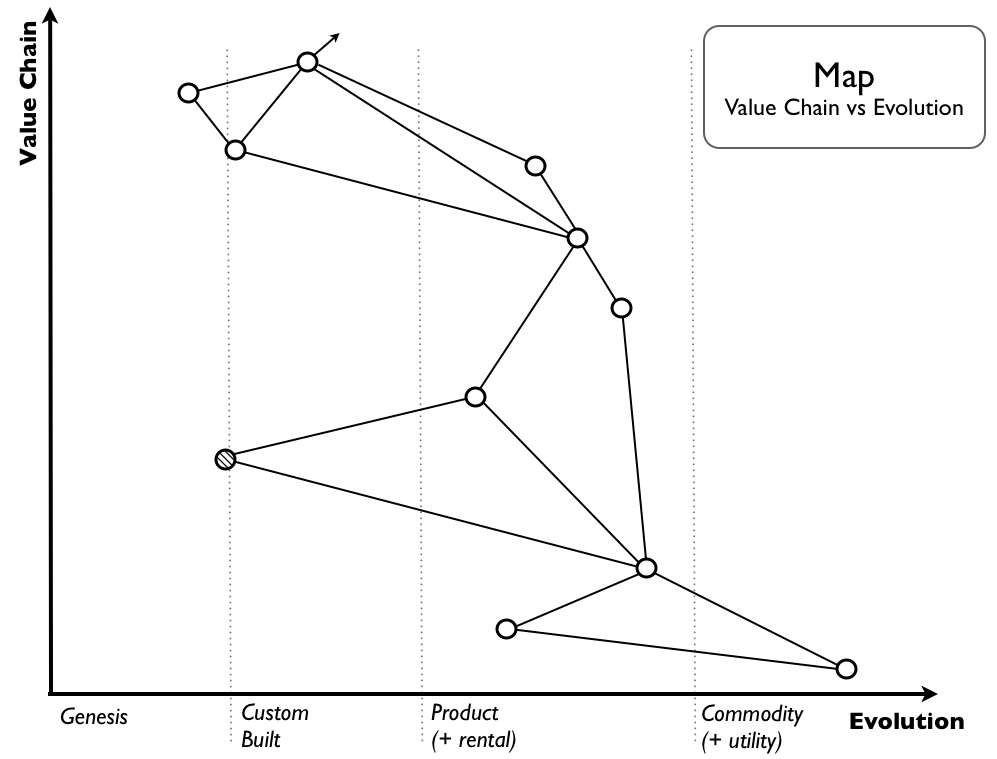
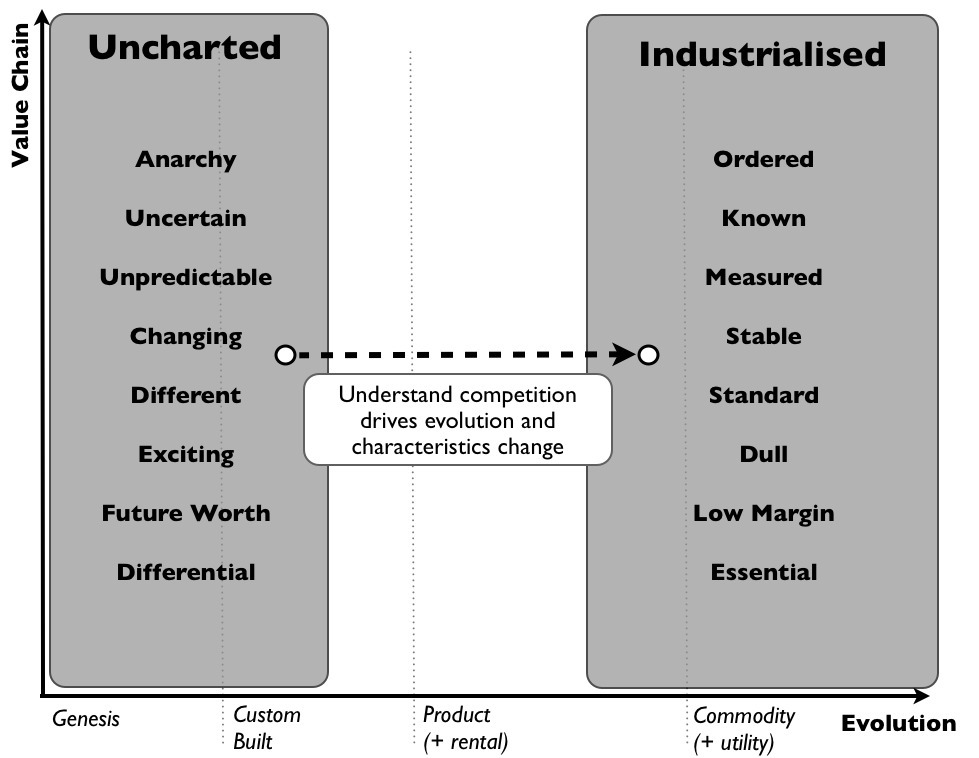
Ok, we all know that organisations consist of value chains (figure 1) which consist of components that are evolving (figure 2) and that you can map this (figure 3). As those components evolve their characteristics change (figure 4) and the methods you need to apply vary (figure 5) hence you need to treat your value chains as units (figure 6). You can manipulate this environment through a whole host of techniques. Furthermore, if you count up the frequency of activities at different stages you can build a profile for an organisation (figure 7) and you apply a structure based upon evolution rather than type (figure 8) with pioneers, settlers and town planners.

Pioneers roughly equals their Builders. Settlers equates to their Improvers and Town Planners equals their Producers. All three groups need Thinkers. All good stuff, cutting edge thinking if you happen to be in 2008 or earlier (we started implementing the structure in 2004/5).

Unfortunately it's 2013 and now it looks like the laggards are finally starting to catch up. Fortunately a four party system based upon the characterisations described in the post will create its own problems and in order to manage this they'll need to have a good grasp of mapping.  Even better news is that without a clue on how evolution actually works then their strategies will still be endless tyrannies of "what and when" over "why", they'll talk about ecosystems but won't understand it and they will probably continue to describe many predictable things as disruptive innovation. They will almost certainly continue to jump between one fad and another - "we're an agile company", "we're a six sigma company" - and many probably won't understand let alone have adopted those next generation practices (figure 10) despite having years to do so.

Word to the wise though, you have to accept that they will eventually cotton on and so the hay days of just walking into an industry and helping yourself may soon be over. The Chancers (figure 11)  might actually start to learn how to fight rather than collapse as their predecessors have - Blockbuster, Kodak etc. Things might soon start to become a whole lot tougher but it'll take time.

Those delightful days of walking in and dominating an entire industry like cloud computing for less than a few hundred thousand dollars are gone.  Pity but don't worry, they will come again and we've still got a few years left to play the game before it settles down. By then the new worlds of 3D printing and intelligent agents should allow us to have fun again with new practices, new ways of dealing with evolutionary flow and new concepts to experiment with.

To describe the last decade of industrial competition as being like "stealing candy from a kid" in some quarters is reasonably fair. Biggest problem for the players has been which industry do you want to own next? However, it was always unreasonable to expect it to last. From what I'm reading, people are slowly starting to stumble upon what many of us now take for granted. We should expect companies to become a bit tougher to walk over in the next decade.

Your future competitors will map their environments, they will know how to play the various strategic games, they will build effective ecosystems and organise around evolution and they will have all those next generation characteristics ... get used to it.

So expect lots of books on these topics invariably described as "break through thinking" and "gaining competitive advantage through structure" and try not to laugh. Because the real joke may end up on us if we're not careful. The easy street is over and we have to move on, to find the new mechanism of exploitation to give us another good 5-10 year run of trampling once again. We need to get even tougher.

We should never ever forget that those models of understanding that create an advantage will eventually end up in a book somewhere. By which time any advantage has long gone and we need to have moved on as well.  But then, life just wouldn't be exciting if this wasn't the case.  If it wasn't for the laggards eventually catching up then we would never have to progress. Nothing is permanent, all practices and activities evolve and diffuse. Embrace this.

So celebrate this awakening, know that new mechanisms will be found as old mechanisms become common.  It'll take a decade for the practices to have spread by which time we will be chowing down on industries with new techniques that we haven't even yet considered ... just don't rest on your laurels. That's the way you become a laggard.

Happy hunting.

Figure 1 - Needs to Value Chain (circa 2005)


Figure 2 - Understand Evolution (circa 2005)


Figure 3 - Map (circa 2005)


Figure 4 - Characteristics Change (circa 2005)


Figure 5 - Different Methods (circa 2006)


Figure 6 - Treat as Units (circa 2006)


Figure 7 - Profile (circa 2008)


Figure 8 - Build a structure which reflects evolutions (circa 2008)


Figure 9 - Implement (circa 2008)


Figure 10 - Next Generation Practices (circa 2011)


Figure 11 - Classification of companies by level of strategic play vs use of open (circa 2012)


Saturday, May 18, 2013

Two Scenarios

As an exercise, read the following two scenarios and give them both a score out of ten for plausibility of occurring. Did you notice anything?


Scenario 1

CIO: “All systems are operational this morning”

CEO: “Excellent news. Apparently the latest thing is cloud. According to this business magazine report 67% of successful companies are using them. We should look into that”

CIO: “Certainly. The latest research I have says that private clouds are the things to build as they’ve now entered the plateau of performance and provide an extremely efficient mechanism of infrastructure provision over our existing technology.”

CEO: “Excellent work. Well let’s look at getting a private cloud up and running.  We don’t want to be left behind in this technology war.”


Scenario 2

Corporal: “New Cannon arrived, as per orders we installed them and fired them this morning”

General: “Excellent news. According to this article in General’s weekly, over 67% of successful generals bombard hills. Let’s make sure we’re doing that as well.”

Corporal: “Certainly. Our research says the latest things to bombard hills with are mortars, it’s now a mature technology entering the plateau of performance and an extremely efficient mechanism of killing compared to existing technology”

General: “Excellent work. Let's bombard a few hills with mortars then! Don’t want to be left behind in this technology war.”

From Strategy to Mapping to Pioneers

A short and rough set of slides on some very basics of strategy, mapping, evolution and structure.


Steps from Simon Wardley

I put this up because of +Edd Dumbill recent post on a "Speaker for the Crazy". At the heart of this is mapping which if you don't do, you won't get the whole process and so don't worry. Just remind yourself that "67% of successful general are bombarding hills"

Wednesday, May 15, 2013

Why I'm a fan of Bromium

I've been a big fan of Bromium for some time. No, I'm not on the advisory board, nor do I have shares in the company and yes, I do know the founders. However, just because I know someone doesn't mean I'm going to agree with what they are doing.

The reason why I'm a BIG fan of Bromium is because of the approach they have taken to dealing with security.

I used to work in the security industry and I can happily say that a chunk of it is based upon snake oil and fear. The general principle of creating a secure but functionally useful system is based upon solving an impossible problem and with good commercial reasons. However, let me explain why.

A basic understanding of mathematics and a realisation that a computer system is nothing more than a mathematical model would lead anyone to Godel's incompleteness theorem and how trying to build a consistent and complete model is impossible. There is no such thing as a provable universally secure system which is useful. A system can only be described as provably secure within a set of given conditions and assumptions, one of which is that someone doesn't find a new attack vector which hasn't been catered for.

The bits of the security industry I worked in, knows the approach of building a secure system is impossible but it's actually in commercial interests to attempt to continuously solve the impossible.  All these new attack vectors create constant revenue streams, a painting of the Forth bridge so to speak and a constant need for new virus signatures, protection upgrades against malware etc. Oh, and if you don't keep up you might be exposed to new zero day exploits, viruses, malware ... fear, fear, fear ... give us your money.  Of course, this carefully skips over the other issue that protection is always post-event i.e. after the new vector is in the wild, discovered or written by security testers. 

What I most like about Bromium is they don't try to solve the impossible. Bromium doesn't try to stop you from ever being hacked, receiving malware or being hit by a zero day exploit because to do so would be impossible. Instead they accept that you will be hacked and receive zero day exploits. What Bromium focuses on is limitation of the damage and this (unlike the incompleteness theorem) is a more solvable problem.

The principle here is rather simple. If you accept that you will receive a zero day exploit that you've never seen before (and therefore cannot protect against) then what you do is limit the damage to as small and as temporary an environment as possible. In the case of Bromium, every process on the machine (i.e. every browser tab, every individual email) runs in a hardware isolated micro VM.

Let us suppose an attacker has sent you some previously never seen before zero day exploit in an email which would bypass most standard security protection. Then under Bromium, a successful attack will gain control of a hardware isolated MicroVM which the email runs in. That MicroVM consists of an empty machine plus the attackers email which is all isolated away from everything else (i.e. all your other emails, files etc). Of course, as soon as the user closes the browser tab or the email then the MicroVM including the attacker's malware disappears, returning the machine to its previous "secure" state.

What Bromium has neatly done is not try to solve the impossible (preventing you from being attacked) but instead limited any damage to as small and as temporary a space as possible. Hence whilst Bromium does not prevent any zero day exploits being run, it reduces the impact of them to practically negligible. The fear is gone. Just because one email has been compromised, doesn't impact all the other emails or the other applications and environments on my machine. It's all isolated and to get rid of the problem I just close that email.

Now this doesn't solve all the issues of security by a long shot, it's no magic bullet. There are numerous other attack vectors such as wetware and social engineering attacks. But what it does do is threaten to disrupt an entire branch of the security industry which in my view needs to be disrupted and has become an unwelcome leech.

This is why I am BIG fan. Oh, forget that ... I'm a HUGE fan. Go, Go Bromium.

I like people who find difficult problems and attempt to solve them by attacking the solvable bit (e.g. limitation of damage) rather than trying to solve the knowingly impossible which also happens to generate them continual revenue streams.

Sunday, May 12, 2013

In search of two better terms - Chaotic vs Linear

Many years ago (getting on for a decade now) when dealing with the issues of diffusion and how changes not only diffused but evolved, I developed the following graph to describe evolution (see figure 1).

Figure 1 - Evolution


The graph is based upon two axis. One of ubiquity which measured how widespread and commonplace the notion of something was and certainty which measured how well defined & well understood something was. 

By measuring the change of the style of publications related to the act then different domains were highlighted i.e. for activities (things we do) we have :-
  • Genesis : where publications tend to refer to the wonder of the thing.
  • Custom built : where publications refer to the building, construction and awareness.
  • Product : where publications refer to operation, maintenance and feature differentiation
  • Commodity : where publications are dominated by use, i.e. what is built with or on, guides for maximising use etc.
This process of evolution covers activities (what we do), practices (how we do things) and data. Each of these evolve through similar states in terms of characteristics, though the terms we use are different i.e. activities evolve from genesis to commodity, practices from novel to best.

Each component can evolve independently or in certain cases co-evolve for example with computing infrastructure provided as a product we had novel practices for architecture which evolved to become best practices (scale-up, disaster recovery, N+1). As the act of computing infrastructure itself evolved to more of a utility then novel architectural practices appeared and are currently evolving (scale-out, chaos engines, design for failure).  Hence best architectural practice for an activity provided through a product is not the same as best architectural practice for an activity provided through a utility.

To understand the connections we need to invoke mapping techniques but that's another conversation. What I'm looking at is one of the underpinning axis of mapping ... evolution.

By 2008, I had amassed several thousand data points providing the same pattern and the causation had been modelled (simple competition including user and supply). However, one thing has niggled me from the beginning. Back when I started to collect the data, I needed descriptive terms to describe the characteristics of the extremes of evolution with the in-between state being a transition from one to another.

At one extreme you had the un-modelled, the uncertain, the constantly changing, the unpredictable, lacking agreement and convergence, the novel and rare, the exciting (in terms of future potential) and the poorly understood. 

At the other extreme, the same act would evolve to the understood, the stable, the predictable, the measured, the agreed and converged, the common and widespread, the dull, mastery of perceived simple operation.

The latter simple operation is important as the actual act through standard interfaces often hides a world of complexity in the same manner that putting a plug into a socket and switching it on hides the complexity of electrical generation and distribution from the consumer. We have a perceived notion of mastery - we socket the plug and switch on - and expect power to be delivered. We are often unaware of the myriad of systems - some simple, some complex - that enable this. Our notion of mastery is only shaken when our expected outcome is not delivered.

The same holds with currency. When I hand over a pound to buy my 20p newspaper I have an expected outcome. I don't expect to get a varying amount of change in return. When I turn on the taps, I expect to get running water not nothing, not sand, not sludge and not a fizzy drink. It's our expectation of a simple linear type operation which is essential in defining commodity and utility despite the actual complexity of any systems the interface obscures.

I struggled with finding terms to describe these two extremes of evolution. Nothing was truly suitable. I could use chaotic vs ordered but this implied a permanence in state and the terminology was confusing. I did however find a descriptive framework in Stacey's Matrix, which had axis of certainty and agreement. One extreme was chaos and anarchy (low certainty and agreement), the other was simple (high certainty and agreement). See figure 2

Figure 2 - Stacey's Matrix


Simple in this term referred to a simple linear type operation and on reading a paper by Roger's which discussed how things not only diffused but as footnote mentioned how they matured becoming less chaotic and more linear in appearance, I decided to use the terms Chaotic vs Linear to describe the extremes. However, I've never been happy with those descriptive terms mainly because the notion linear degenerates quickly into linear / non-linear systems and the notion of chaotic quickly degenerates itself into other discussions.

So, finally, after all these years, I'm revisiting this and looking for two terms which more aptly describe the characteristics of the extremes i.e.

Something more apt than "chaotic" to describe characteristics of the un-modelled, the uncertain, the constantly changing, the unpredictable, lacking agreement and convergence, the novel and rare, the exciting (in terms of future potential) and the poorly understood. 

Something more apt than "linear"to describe characteristics of the understood, the certain, the stable, the predictable, the measured, the agreed and converged, the common and widespread, the dull with  mastery of perceived simple operation.

A good friend of mine @jamesurquhart has suggested "wild" vs "domesticated". I actually quite like that as descriptive terms for the characteristics of the extreme (see figure 3). I'm hoping someone might have a better suggestion.

Figure 3 - Wild vs Domesticated


What I want to avoid is meaningless or confusing terms such as "innovation" which is equally used to describe genesis of something, feature differentiation of a product or more evolved models of providing pre-existing activities. I'm looking for something more apt in describing those characteristics which is not tarnished by common use or loaded with other connotations

Tuesday, April 30, 2013

The Fast Follower Conundrum

I was asked a really odd question recently - "Should a company be a first mover or fast follower of innovation?"

I responded "Both!"

To explain why requires a long post covering value, perceived value, componentisation and evolution. This won't be an easy ride for those new to my work but manageable for those who are familiar.

An idea is something with social value and the implementation of that idea as a new act can creates economic value, if that act provides a differential between companies and if it is useful. This process of transformation from social to economic value is known as commodification.

As that activity evolves, the various iterations will individually diffuse through society until the activity becomes commonplace, well understood and its differential benefit reduces to close to zero i.e. what started with a high differential value due to its scarcity ultimately evolves to have little or no differential value because it is commonplace. It has become a commodity and when discussing activities then this process of evolution (see figure 1) is commonly known as commoditisation

Often the two terms are confused but commodification and commoditisation are separate.

Figure 1 - Evolution (aka commoditisation when dealing with activities)


At the same time that an act commoditizes and its differential value declines, it also becomes a necessity and a cost of doing business. For example, the once wonder and differential of a mobile phone has become a cheap necessity for most. This creates a situation where the unit value of something maybe declining as it becomes more common (i.e. less scarce) but the total value is increasing due to volume. This is summarized in Jin Chen’s “Entropy Theory of Value” and the relationship between value and scarcity is provided in Figure 2.

Figure 2 - Total and Unit Value variation with scarcity.


From the figure above, as the act become increasingly more common (moving from left to right along the scarcity axis) then the unit value declines but the total value (volume multiplied by unit value) reaches a maximum before declining. Along with a change in value, we also see the cost of production of each unit reducing with volume. For example, the cost of production per unit for a standard mobile phone is vastly less than the cost of production of the first ever mobile phone. As a result the Transitional phase (the domain of custom built and products) also tends to be associated with the most profitable with the highest total value and declining production costs. In practice, this area of highest profitability tends to extend further than anticipated because the economic value associated with an activity tends to exceed the differential value it actually brings us due to effects such as branding, confusion of choice, poor information and our inability to determine actual value. Even today we tend to view systems such as financial ERP (Enterprise Resource Planning) as providing some form of differential value despite the commonplace use of ERP systems and wide spread copying of customization. Hence we often associate more economic value to ERP than we should i.e. our perceived value often exceeds the actual value something creates. This effect is quite common.

Notwithstanding the issue of perceived vs. actual benefit, the general form of how benefit (e.g. total value minus cost of production) varies with evolution for a new activity is shown figure 3. A similar pattern also occurs with changes that provide operational improvements and are hidden behind the interfaces of standard components.

Figure 3 - Benefit vs Evolution


From the figure above, the genesis of an activity is normally associated with a negative benefit due to the burden of research and development costs, however these are quickly overtaken by rapidly increasing sales volume for a relative high margin product. As the activity evolves the unit value declines along with production costs to achieve a minimum plateau.


Summing the area under the benefit graph can provide us with a total future benefit. Obviously, we have no idea whether a novel activity will succeed but assuming it does succeed and evolves to more of a commodity then we can estimate an anticipated future benefit.  It is anticipated, as the actual future benefit will depend upon the act in question, whether it succeeds, how useful it is, whether it diffuses and crosses the chasm, whether it is substituted by another act, and ignores interference in the market (e.g. intellectual property rights).  The general form of anticipated future benefit vs. certainty is provided in figure 4

Figure 4 - Future Benefit vs Evolution


So for any act, the future benefit grows in the initial stages to a maximum i.e. the impact of research and development reduces. Once this maximum has been reached then the future anticipated benefit has an inverse relationship with certainty and as the act becomes widespread and well defined its future benefit hits a minimal plateau. Alas, for any specific act, since we have no way of peering into the future and those things with high future value are equally those things we are less certain about then gambling is a necessity.  However, since there is a maximum, Fast followers who make custom built examples of the act and then go onto productise it will gain the maximum advantage. In general: -

The Chaotic phase (for activities, genesis of the novel and new) is associated with high costs, high levels of uncertainty but potentially very high future values. Being first is not always the best option though.

The Transitional phase (for the activities, custom built and products) is associated with reducing uncertainty, declining production costs, increasing volumes and highest actual benefit and hence profitability. Whilst the environment has become more predictable, the future anticipated benefit is also in decline. This accelerates, as the activity becomes more commonplace, more defined and more of an expected norm.

The Linear phase (for activities, the domain of commodity and utility services) is associated with high certainty, high levels of predictability, high volumes, low production costs and low unit margin. The activity is not seen as a differential but an expected norm, it has become commonplace. Those activities that have evolved to this state (e.g. nuts and bolts) are seen as having minimal differential value and the perceived future benefit is minimal. However, despite this they also provide a regular and sustainable source of revenue.

If we take these different areas of value and superimpose on a figure showing how evolution enables the rapid development of higher order systems (see figure 5) then we see that the new higher order systems are also associated with highest future benefit whereas the underlying components are associated with minimal future benefit (in terms of differential).

Figure 5 - Evolution, Componentization and Value


As a result, when an activity evolves to more of a commodity we not only see higher levels of efficiency and increased agility in building higher order systems but we also tend to see a flow of capital from past industries to these new industries because they are perceived as the source of future value or wealth. This flow of capital to the “new” is part of the phenomenon that we know as Creative Destruction by Joseph Schumpeter.

The future benefit curve applies equally to differential value with the creation of novel and new things as it does to operational improvements and provision of a more evolved component. However, the fast follower method is more appropriate when we are discussing the creation of something novel and new rather than a more evolved means of providing an existing activity. In the latter case, being a fast follower to a more commodity means of provision has an additional burden in terms of a company’s ability to create and extract benefit from higher order systems.

Figure 6 provides a future benefit curve for both the creation of something novel and new (e.g. computer infrastructure in 1943) and the provision of a more evolved method of providing an existing act (e.g. utility provision of computing infrastructure in 2006).

Figure 6 - Future Benefit and Evolution


From the above, in 2006, the act of using computing infrastructure can be considered as having little or no future benefit in terms of differential value and instead is simply a cost of doing business. The shift towards utility provision in 2006 does provide some operational impact that quickly declines and a maximum benefit is always possible by not being the first to adopt due to the cost associated with changing practices.

However, in the case of utility provision there is also the impact on creating higher order systems (componentisation) to be considered. In other words, being a fast follower for utility provision of computing infrastructure might maximise operational efficiency but it will incur an additional opportunity costs in building higher order systems. In which case, depending upon how widespread the component will be, the act of being a fast follower may prevent a company from being a fast follower in those higher order systems that represent future sources of wealth (see figure 7).

Figure 7 – Impact of Fast Following on higher order systems


From the above, as the activity evolves from a product to utility provision, both consumers and past vendors have inertia to the change.  The more evolved method of provision offers some benefits through operational efficiency and being a fast follower maximises this benefit due to any changing practices associated with the act. However, the more evolved act also enables new higher order systems to form that in turn are new sources of future value. Being a fast follower in implementing the more evolved activity may impact a company’s ability to be a fast follower in implementing these new sources of future wealth.

A general rule of thumb is therefore provided in figure 8. Being a fast follower generally creates the maximum advantage when we’re talking about the genesis of something novel and new (i.e. an act which has not existed before). However, being a first mover can create the maximum advantage when dealing with the evolution of a pre-existing activity from product to utility services due to componentisation effects.

Figure 8 - Evolution and Fast Follower


Ideally a company wants to be a first mover when it comes to commoditisation but a fast follower when it comes to genesis. This is also why ecosystems are incredibly powerful models, as the approach of ILC (innovate-leverage-commoditise) creates a constant position of being a fast follower to genesis (i.e. others innovate, you leverage the ecosystem to spot diffusion) whilst at the same time the act of commoditising means you're a first mover (see figure 9 & 10)

Figure 9 - The ILC model


Figure 10 - Example operation of model


The original question also highlighted why the general use of the term “innovation” to cover multiple things (genesis, feature differentiation, utility provision of an existing act) is so confusing because the answer to  “should you be a fast follower or first mover with innovation” is “both”. 

Ideally, you want to be a fast follower to Genesis but a first mover to Utility provision.

12th August 2015

These days I use the term uncharted for the chaotic phase (the appearance of chaotic like properties is just one of many characteristics for that phase) and industrialised for the linear phase (the appearance of linear like properties is just one of many characteristics for that phase). The chaotic and linear terms (ones I had used since the mid 2000s) didn't amply describe the phases.

I still call the transitional phase ... transitional. It amply describes the "in-between" state.

Sunday, April 14, 2013

Thatcher's Legacy

Controversy still surrounds the "not quite" state funeral of Margaret Thatcher. A ComRes poll of 2,012 found strong opposition to state funding with 60% against and 25% for. So, it really isn't that controversial - the public don't want it, the Government isn't listening. Even the Bishop of Grantham (the Iron Lady's home town) has called the funeral a mistake. Unless you're in the midst of a swelling of the rabid right, you're unlikely to find support for it.

The DailyMail (a wet rag of a newspaper more commonly associated with picture book Victoria Secret's exclusives than journalism) continues its "witch hunt against the living whom might speak ill of the dead". Two teachers, a policeman and a student so far. It naturally has forgotten its own disgraceful character assassination of the opposition Leader Michael Foot, two days after his death. Well, it happened in 2010 ... that's like ancient history. The DailyMail, a staunch fighter for press and media freedom, has also been ranting against the BBC for allowing the DingDong song to be played.

Under political and media pressure the bumbling BBC has decided to cut short Judy Garland's song 'Ding Ding the Witch is Dead' in the chart show. According to the DailyMail the failure to censor  the song hands victory to the 'Trots and Loony Left'. Iron Lady supporters have their own anthem with the bizarrely co-opted anti-Thatcher song 'I love Margaret Thatcher'. The BBC has decided not to cut this latter song despite the song's success representing exactly the same sort of political gesturing that some wanted the previous song censored for.

Glenda Jackson has also been castigated by many of the rabid right for speaking her own mind in an attempt to stop Margaret Thatcher's history being re-written. Glenda has received overwhelming public support for this. The DailyMail called her "demented".

Will Hutton has asked a perfectly reasonable set of questions on the legend of the Iron Lady saving Britain and whether all that happened was a set of short-term measures (selling national assets, credit de-regulation) to fuel a debt driven boom. I'm sure shouts of controversy with demands for censorship, persecution and castigation will follow in short order.

... and so it has continued.

Now, we could talk about the economic and political policies of Lady T's reign. Some were fine, others were not. But you have to understand that to some of the right, Lady T was their deity. Hence all the hostility against those who doubt her and the desire to worship such a divisive idol. In their world, you're either a paid up member of the rabid right or you're a demented member of the loony left. There is no shades of grey (oh, and just in case you're in doubt then there are some on the left who are just as equally blinkered of the other side).

So any discussion of Thatcher's legacy is bound to be fraught with trouble. The reality is there was some good and bad, depending upon who you were. The longer term effects were all cultural - the shift towards short-termism, brutal individual self interest and a focus on economic dogma over society. Again, whether you think those are a good or a bad thing will depend upon your perspective.

However these demands for censorship, persecution and castigation for failing to worship a specific groups' idol are disturbing. Though there has been talk of 'pre-emptive' arrests, we haven't stooped so low as to arrest people for 'insufficient sobbing' but that's because we still have some fragments of civil liberties left (bleeding heart liberal that I am).

Expect more name calling, rabid ranting and persecution of the living.