Tuesday, April 05, 2016

What's in a Wardley Map and the need for a cheat sheet.

A map has an anchor. In chess, it's the board. In geographical maps it's the compass. In a Wardley map, it's the user need (of course, I'm assuming you've actually described the user journey and know what those needs are).


A map has position (relative to the anchor) and the ability to show movement. In Chess, it's the position of pieces on the board and where they can move to. In geographical maps, it's the position relative to compass setting (northwest of here or in more advanced forms, GPS) and the features that enable or hinder movement (a cliff, a road). In a Wardley map, position is shown through a chain of needs and how visible the component is to the user (the anchor) whilst movement is shown through evolution.


There are many types of pieces on a map. In Chess, well that's obvious. In geographical maps these are landmarks or troops (in combat). In a Wardley map, you have many different types of activities, practices, data and knowledge. 


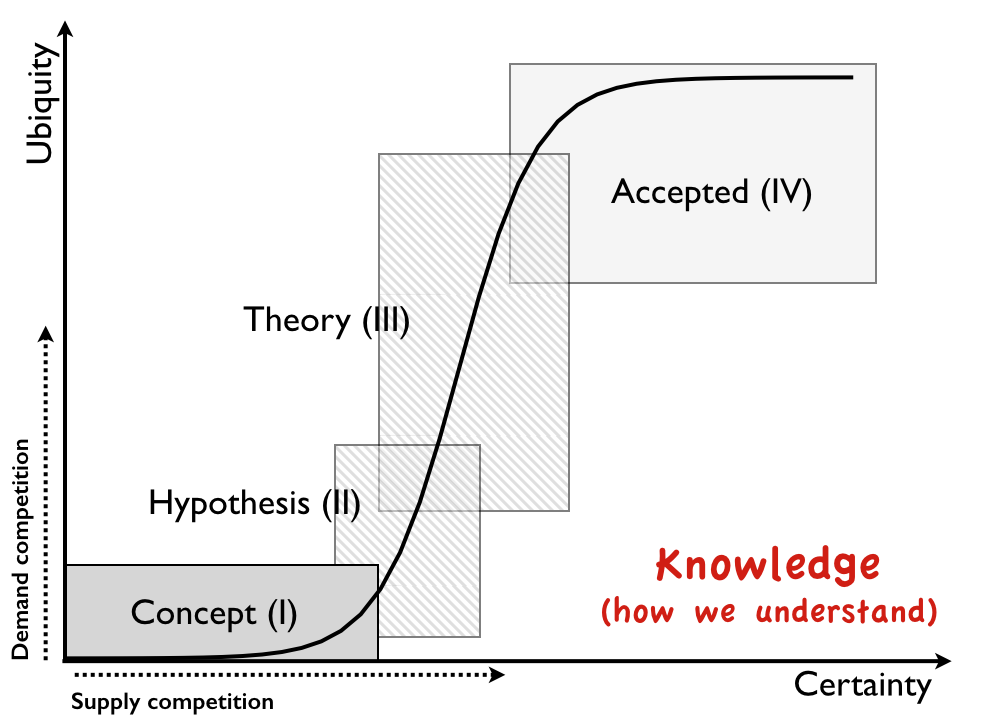
All of these types in a Wardley map are evolving and co-evolving. The x-axis is just short-hand for evolution and I chose activity as the most useful description. But all of these types evolve through different stages (I to IV) over ubiquity and certainty. This is driven by competition and causes common characteristic changes.


Unfortunately, to see evolution then you have to abolish time and measure over ubiquity vs certainty. This is not adoption vs time (a diffusion curve) which measures diffusion. Diffusion and Evolution are not the same thing but they are related (i.e. evolution consists of many diffusion curves).

Because we have no crystal ball (i.e. you can't measure evolution over time and predict the future accurately) then you have to deal with the certainty axis and that things start of as uncertain. In practice this means you can only accurately map where something WAS once it has become a commodity. To estimate where something IS then you have to use weak signals or discussion between a group familiar with the field. Evolution just shows you the path, the future still remains an uncertainty barrier we can't peak through but we can approximate.

The cheat sheet (more accurately, my cheat sheet) is based upon weak signals for each stage (I to IV) and is broadly applicable across all types (some of the characteristics are specific to a type but it's a good enough approximation).


Once you have a map of your landscape, you can start to learn about common climatic patterns, use it to apply universal doctrine such as removing duplication and bias, use it to communicate and challenge assumptions, use it for context specific gameplay (i.e. strategy) and learning of such, use it to link strategy to operations, use it determine flow, use it for organisation ... in fact, you can do an awful lot with a map.

Four final notes.

1. The only people who can map an industry are those that work in that industry. You have to learn to map and play the game for yourself. By all means you can use consultants to advise on different forms of gameplay (assuming they know any context specific forms) but the only person who can map your environment is ... YOU.

2. No map is "right", it's an approximation and open for challenge. The beauty of drawing a map is that it can be challenged easily. The key to mapping is don't try and create the perfect map but quickly draw the environment and share with others. With practice, you should be able to map a business in a few hours. NB. This means YOU, not someone else.

3. Mapping itself is not "right". These are Babylonian clay tablets for business. Someone will make a better way of mapping. All models are wrong, some are however "useful". Trying to determine strategy or operate a company without understanding your landscape is something that I don't find to be useful.

4. The Wardley Mapping technique is creative commons share alike, it has been for almost a decade. I found it useful, so I gave it away in the hope that others would. 

Tuesday, March 29, 2016

On speaking at Mendix World

I've been invited to speak at Mendix World later this year and their press people have asked me some questions for an article. In fact the questions came from Sander van der Meijs, the chief editor of CIO.nl, and they are so interesting that I'm going to respond here as well.

Q 1. You say companies often do not have a strategy. The only strategy they have is copying other companies that seem to be successful. What does this mean in the context of software development? How can organizations break free from this ‘copy cat’ mentality?

On the contrary, companies often have oodles of strategy but it is based upon poor situational awareness (i.e. little understanding of the environment). Without situational awareness then you are forced to rely on verbal reasoning and meme copying others including the use of backward causality without context. In other words, the general mantra becomes "if A does B and A is successful then if we do B then we too will be successful!"

Dilbert has a fabulous cartoon for this.

As Professor Martin says, managers are busy people and there's an army of consultants willing to provide these "solutions" of copying others. In management theory we even write books encouraging others to simply copy the greats of Kodak or Atari. If you want to break free of simply copying others then you have to get to grips with the environment and improve your situational awareness.

Q2. Agile development is often used because of the hype. But in your top predictions for 2016, you suggest that one size does not fit all. What are views on where agile is best applied and how to manage multiple methodologies within one organization?

Agile development was something I used extensively back in the early 2000s. However, it soon became clear that it was not suitable in every circumstance. This echoed the Salaman and Storey Innovation paradox of 2002 that in order be efficient you needed to use one set of principles and in order to innovate you had to replace such erstwhile practices. Though we experimented with dual structures within the organisation, this quickly degenerated and we discovered that we needed three basic sets of methods and techniques to manage the process of evolution. This echoed Robert X. Cringley's description of three organisational types in Accidental Empire, 1993.

In order to do this in practice we needed to understand the environment and how evolved the components of any system are. This is something mapping enabled us to do by 2005 in a more formal way.

So, Agile (as in a focus on the core agile principles) is a perfectly reasonable technique for exploring the uncharted space of the novel and new because you need to reduce the cost of change as change is the norm. By the time the activity becomes industrialised then you need to focus on reducing deviation and hence a different set of approaches is needed e.g. six sigma. What people often fail to realise is there exists a huge chasm between these two extremes and this needs to be managed. In this middle or transitional stage then you need to focus on learning and reducing waste around the activity. Back in 2005, we were struggling to find consistent mechanisms for this but since then Lean (which uses a more formalised Agile approach e.g. Scrum with artefacts such as MVP - minimal viable product) has emerged as the most suitable.

Q3. Another one of your predictions was focusing on user needs, which aligns nicely with your Value Chain Mapping framework. Describe this framework and how it helps organizations align their business priorities with user/customer needs.

In order to map an environment (LEF members / general public info) you need two key aspects - position and movement e.g. position of the pieces on a chess board and where they can move to. In order to determine position you need an anchor. In the case of a chessboard this is the board itself. In the case of a geographic map it's the compass. In the case of business, the original (and so far yet to be surpassed) anchor that I used back in 2005 was the user and their needs. 

From the user need you can then develop a value chain which gives the position of components (in terms of visibility) relative to the user i.e. if you're making a cup of tea then the electricity provider that you're using to provide power for the kettle is not a visible user need but nevertheless it's still an important component far down the value chain. The power is needed for the kettle, the kettle is needed for hot water, the hot water is needed for the tea and tea is what the user needs.

However, position is not enough. You also need to understand how things can move and in business we're talking about how things can evolve. If you don't understand how evolved the component is then someone might start building a brand new form of kettle rather than buying one off the shelf. Back in 2005, I guessed at a useful axis based upon a pattern I noticed in 2004. It wasn't until 2007 that I had collected the 9,000 odd data points to justify the process of evolution (i.e. genesis to custom built to product to commodity) as being moderately sound.

Once you have a map (and it's a relatively simple task which takes someone with reasonable skills a few hours) then it become trivial to identify duplication, bias, poor contract structure, misapplication of methods and poor structural design with a company. The maps also help with collaboration, communication, linking operations to strategy and getting everyone focused on the user need and where their part of the map fits into providing the overall user need.

Over time and practice you can use the map to learn about common economic patterns, context specific forms of gameplay, universal doctrine and anticipate change in much the same you learn to play a game of chess. For example, there's at least two forms of basic disruption - one of which can be anticipated and one of which can't. However the failure to understand the environment means that companies are constantly being disrupted by anticipatable change that can be easily defended against if only they could see it.

Of course, once learned then lessons can re-applied to other contexts as appropriate i.e. in the military world we learned to use flanking and pincer movement across multiple battles. This is all part of the process of determining strategy and it's here you should determine your priority order. There is no general priority list, it's specific to the context and the game at hand.

Q4. You also developed the model with pioneers, settlers and town planners. Where did you get the idea, how did you develop it and how does it work? Are there situations where more or fewer operating modes are required or more suitable?

The premise of using a three party structure - e.g. pioneer, settler and town planner (nb, the LEF post is from 2011 and uses some older terms which I've since tidied up) - was developed by James Duncan and myself back in 2005 in order to solve the problem caused by a dual structure and its origin is Cringley's Accidental Empires, 1993. I've talked on the topic at numerous public events and in publications since 2007. 

Once you map an environment, the first thing to do is to apply "common" doctrine. One of the things about mapping is that it teaches you that some techniques are context specific whilst some are fairly universal. Doctrine are those techniques which are not context specific but universal and can be applied & copied to almost all circumstances. Unfortunately there are vastly more context specific techniques than those which aren't and hence the problem with simply copying others. For example, you might look at surge pricing in Uber and see that as a technique that is helping Uber become successful. That doesn't mean that you can simply copy and apply the technique to funeral parlours and expect the same results.

One of these universal doctrines is to break down the problem into small teams (today you'd think of Amazon two pizza model or Haier's cell based structure). The FIST principles of Lt Col Dan Ward, USAF are also highly applicable. However, once broken down you should note that each team not only has aptitude (e.g. finance, engineering, marketing and security skills for example) but also attitude (i.e. engineering in the uncharted world is not the same as engineering in the industrialised). Hence once you have a cell based structure, you need to add in attitude which is the purpose of pioneers, settlers and town planners. It's a recognition that we have at least three different attitudes and people tend to excel at one of these. 

Some people do well in the high speed and chaotic world of brilliant flashes and failure and can discover the new spaces of future industry. Whilst others are good at turning the half functioning brilliant flash into something people might actually want to use. This is no mean feat and these are the people that make success happen. There are also others who can turn the more matured thing into a highly industrialised form and build the empires of scale. All three types of people are brilliant in different ways. You need all three.

In order to function and to overcome any tendency towards inertia, you also need to introduce a concept of theft to mimic evolution within the structure i.e. settlers steal from the pioneers and turn the brilliant flash into something useful hence forcing pioneers to move on and do more "pioneering". Town planner steal from settlers and build the component services that pioneers use. It creates a virtuous circle which is what we noticed back in 2005 when it was first used.

There are ways to cut out some of the stages e.g. through the use of ecosystem but this requires very high levels of situational awareness and skill which I rarely see outside of areas where competition is at its fiercest and most critical. Most commercial organisations can get by with simply using cell based structures and keeping in mind the different attitudes.

Q5. What do companies need in addition to the model to be successful?

A map. The issues of culture, organisational structure, strategic gameplay and learning are all quite complex and without a map (i.e. position and movement) they became almost impossible to decipher hence our tendency to simply copy others (unaware of what is context specific and what is universal), use magic sequences of success (i.e. top ten things the successful do) and focus on the importance of "Why" whilst ignoring the fact that "Why" is a relative term as in why here over there. 

Q6. Where do you see the model in practice right now? What are some of the potential obstacles organizations should be mindful of when implementing it? And how can they overcome them?

Mapping is used in numerous organisations. There are also organisations using a pioneer, settler and town planner like structure but these are rare and for the vast majority of companies then the rigours of competition are such that a cell based structure is more than ample.

Q7. You’re coming to The Netherlands to speak at Mendix World. Do you see the model adopted in Europe as well, maybe even in The Netherlands?

The mapping work is creative commons share alike and is used by numerous organisations, in fact I wouldn't even know how many because of its open nature. My concern however is not this but that members of the LEF continue to improve situational awareness & gameplay whilst not getting dragged into following paths which are known to cause problems. I have no particular strong interest in whether other companies adopt the mechanisms of mapping or not. In fact, I know some members who would actively discourage others from using it!

On the question of why I'm speaking at Mendix world. I'm coming along to listen, to catch up with good friends and in the hope of serendipity. You never know what you might discover by chance.

Friday, February 12, 2016

Looking at Amazon and Lumberyard a bit more.

Last time I wrote about Amazon and gaming and since that post Phil Trease produced a very nice map on Lumberyard which I've blatantly stolen and added here.

Figure 1 - Phil Trease's map

Now the beauty of a map, is that I can challenge it e.g. the assumptions made, the components used. I also happened to listen to @Cheeseplus provide some very useful commentary. So, I decided to have a bash myself and redo that map.

A few things :-
1) the user need really should start with entertainment which of course needs access to a means of providing it.
2) content is actually a pipeline from the brand new and commissioned games to the somewhat tired and older titles.
3) many of the items seem more commodity than displayed on the map above, so I've used my cheat sheet to determined how evolved the components are. 

Figure 2 - Evolution by Type.


Figure 3 - My cheat sheet for Evolution


So, I've now created two maps. My pre-Lumberyard map and my post-Lumberyard map. Lets go through each.

Figure 4 - Pre-Lumberyard


In this map, access to entertainment is provided through the device and there are two main forms either immersive 2D (including 3D like experience though a 2D screen) and 3D immersive (e.g. VR / AR). This obviously depends upon content and there's a pipeline (in blue for this) on which I've guessed where most 3D content is (approaching useful products but still mostly under development).

Now content requires a delivery mechanism (e.g. App Store and a gaming platform) and also commissioned games require someone to commission and build them e.g. a Creative Games Studio. I've then marked on a whole bunch of underlying components.

Do remember, the amount of experience that I have in the gaming world is zero hours. This map is from a complete outsiders view, derived from Trease's map and it took about 30 minutes. So lets modify the map by moving pieces to represent where I think Lumberyard is taking it (see figure 5).

Figure 5 - Post-Lumberyard


So, a couple of points to note with this map. First, in the bottom right hand corner you have all those components related to gaming (i.e. design tools, gaming engine, environment) being industrialised to more commodity components by Lumberyard. I talked about this extensively in the last post with endless mocking words of encouragement for Gaming CEOs. But there are some other potential impacts here.

From the map above, I've displayed creative studios as having constraints (e.g. access to good designers and access to the components needed to build big games). By industrialising these components then you're likely to see both more game designers and creative studios as the barriers to entry tumble. Hence you're also likely to see a much faster throughput of game in the pipeline.  So, it's not just companies involved in game components that'll take a hit but those big name studios will. Of course, in the early days those creative studios will probably support Lumberyard as a way of reducing cost, almost oblivious to the impact that by doing so they will increase competition in their own market. This is what we call Fool's mate and it's surprisingly effective and easy to use. It relies on competing CEOs being blind as a bat caught unaware by random change

Of course, if studios weaken due to reduced barriers to entry then the reason why people will want to work for a studio will not be because it has access to kit but because other "great" designers work there. So, these changes would likely lead to even more superstar game designers (just in case they weren't already) along with superstar teams and less emphasis on the creative studio.

Another impact could well be the separation of artistic direction from creative studios. This may already be happening, I wouldn't know as I don't know anything about gaming and I'm simply basing this on a map which is probably wrong because I don't work in the industry. However, in this speculated environment then commissioning and artistic direction is provided by the channel (e.g. the app store owner) and creative studios are simply commissioned to provide work. The app store literally becomes the gaming "channel". So between superstar designers, artistic direction set by the channels and increased competition then big name studios might find they are in for a rough ride. Of course, all the time Amazon could be mining meta-data to find new things developers and consumers find useful under the old ILC model which means you have two Hopes - Bob and No - and Bob has left town.

Finally, under the map a big area to watch is in the 3D immersive (AR/VR) space. With more content being produced, more designers, a change to commissioning models, weaker creative studios then control is about the app market and hence also the device. So, don't be surprised if later on Amazon makes a play into this space as well.

Is this correct? Well, I know nothing about gaming and I spent 30 minutes on the map. So, no this is not right. I'd expect someone with experience of gaming to be able to quickly make the map better.

Do gaming companies have maps? Well, given gamers have been using maps and advanced forms of strategic play for a long time then you'd hope someone in the executive suite has gone - "Oh, that's a good idea". Chances are they haven't which is why they'll be unprepared, full of inertia and ultimately lose this space. 

Can Amazon be counter-played? Of course. How? Alas, I'm far more interested in watching another industry implode as it gives me a useful data point for my own research than I am in helping save them. I'll just warn you what I suspect is going to happen, I'm not going fix it for you nor tell you how to fix it. That's your CEOs job, not mine.

Tuesday, February 09, 2016

What to do about Amazon and Gaming

So Amazon has finally launched Lumberyard (its own gaming engine). This should come as no surprise to anyone as Amazon has been signalling for the last four years that it was building up to get into gaming. Actually, when I say signalling, I mean flashing thousand foot neon signs blasting out the words "We're getting into gaming" ... it has been that subtle.

Of course, I'm sure some execs in some gaming companies are bound to be surprised. They shouldn't be. If they are, they should be truly stunned that they've been getting paid for obviously not doing their job. This would be such a pity given the high calibre and wealth of strategic talent that gaming companies have had access to. However, that said lets go through the basics.

I've previously talked about the use of mapping, how everything evolves and common economic cycles such as peace, war and wonder. The basic structure of peace, war and wonder is as follows (taken from Jan 2013 Revolution post).

The Basics

Peace - the time of products
Competition is between suppliers of products with constant feature improvement. Whilst disruptive change and new entrants do occur (e.g. a new component of the value chain appears and former products are substituted), the majority of change is gradual and sustaining of those competing companies. It is a time of high margin, increasing understanding of customer needs, the introduction of rental services and relative competition i.e. a jostle for position between giant competitors. 

Because of success, inertia to change builds up within those giants whilst the activity itself continues to evolve becoming more widespread, better understood and declining in differential value. In the latter stages customers can even start to question whether they are getting a fair benefit for what they are paying but overall, this is a time of peace in that industrial ecosystem.

War - the shift from products to commodity (+utility)
In war, the successful activity has now become commonplace and "well understood". It is now suitable for more commodity or utility provision. It is suitable for industrialisation and the appearance of these more "linear" solutions i.e. the volume operations of good enough through standard interfaces. However, the existing giants have inertia to this change and so it is new entrants that are not encumbered by pre-existing business models that introduce the more commodity form. These new entrants may include former consumers who have gained enough experience to know that this activity should be provided in a different way along with the skills to do it. 

This more commodity form (especially utility services) is often dismissed by most existing customers and suppliers of products who have their own inertia to change. Customers see it as lacking what they need and not fitting in with their norms of operating. However, new customers appear and fairly rapidly the benefits of high rates of agility, innovation (as in genesis of new higher order activities) and efficiency spread. Novel practices and norms of operating also co-evolve and spread. 

Customers who were once dismissive start to trial out the services, pressure mounts for adoption. A trickle rapidly becomes a flood. Past giants who have been lulled into a sense of gradual change by the previous peaceful stage of competition see an exodus. Those same customers who were only recently telling these past giants that they wouldn’t adopt these services, that it didn’t fit their needs and that they needed more tailored offerings like the old products have adapted to the new world.

The new entrants are rapidly becoming the new titans. The former giants have old models that are dying and little stake in this future world. There is little time left to act. The cost to build equivalent services at scale to compete against the new titans is rapidly becoming prohibitive. Many past giants now face disruption and failure. Unable to invest, they often seek to reduce costs in order to return profitability to the former levels they experienced in the peace stage of competition. Their decline accelerates. This stage of competition is where disruptive change exceeds sustaining, it has become a fight for survival and it is a time of War with many corporate casualties. This period of rapid change is know as a punctuated equilibrium.

Wonder - the time of genesis.
In wonder, the activity that is now provided by commodity components has enabled new higher order activities and things that were economically unfeasible a short while before now spread rapidly. Nuts and bolt beget machines. Electricity beget Television. These new activities are by definition novel and uncertain. Whilst they are a gamble and we can’t predict what will happen, they are also potential sources of future wealth. Capital rapidly flows into these new activities. An explosion of growth in new activities and new sources of data occurs. The rate of genesis appears breathtaking. For an average gas lamp lighter there is suddenly electric lights, radio, television, teletyping, telephones, fridges and all manner of wondrous devices in a short time span. 

There’s also disruption as past ways of operating are substituted – gas lamps to electric lights. These changes are often indirect and difficult to predict, for example those that are caused by reduced barriers to entry. The fear that the changes in the previous stage of war (where past giants fail) will cause mass unemployment often lessens because the new industries (built upon the new activities we could not have predicted) will form. 

Despite the maelstrom it is generally a time of marvel and of amazement at new technological progress. Within this smorgasbord of technological delights, the new giants are being established. They will take these new activities into the peace phase of competition. It is a time of Wonder, growth and of bountiful creation of the novel and new.

This pattern of peace, war and wonder repeats throughout history whenever activities evolve to become commodity components of other higher order systems.  In the case of gaming, many of the components of the value chain are suitable for industrialisation to commodity (+utility) components. 


The time of war is upon us in gaming

The time of war is upon us in gaming and many components of the gaming value chain are ripe for shifting from product to commodity (+utility) forms. Amazon is a master of this game. A master? Yes. There is a specific ecosystem model called Innovate-Leverage-Commoditise (ILC) that is designed for use when an activity shifts from product to commodity (+utility). It's incredibly powerful, about a decade old and you can read about it here. Amazon appears to be an expert at this. The net effect is always rapid increases in efficiency, innovation and customer focus.

So, what does this mean for a gaming company? Well, if you're a game designer then it's fabulous - this is going to make your life so much easier and give access to a compelling market. For the independents, the small company players and the users it's going to be great because it's going to become all about the gameplay and the content. You'll see an explosion of new ideas, new & shared content, new forms of gameplay and the barriers to entry will come tumbling down. Whoot! I look forward to the day that the AI which I fought in one FPS follows me as I switch into a space simulation. There's so much potential.

But if you're a gaming company CEO which depends upon on or sells a differentiated game engine (Unity technologies, EA's Frostbite, Autodesk's Stingray, Epic's Unreal Engine, ShiVa, Havok's Vision Engine)  or gaming middleware or any of those others who've relied on barriers to competition (access to compute resources, license costs, access to customer base, visibility of game) then it means your company is toast.

This doesn't mean you can't make money but you've lost this game already and you need to adapt to either designing games on AWS or finding another route. However, what's most likely going to happen is that you're going to first dismiss this move by Amazon and for the next 10 years you're going to be convinced that you were right as Amazon grows to about 3-5% of the gaming market. You're going to see new practices emerge in gaming (co-evolution of practice) but you're going to keep on telling yourself how your gaming engine / middleware / whatever is better. In the following five years everything is going to go to hell in a hand-basket. There is almost nothing you can do, your company will have huge amounts of inertia to the change, your execs will be convinced of their rightness and you are going to lose. Of course, if you plan to retire before that point - well fair game. Your shareholders lose and that's their lookout.

Now, whilst I say there is nothing that YOU can do about this, doesn't mean there is nothing that can be done about it. Problem is, unless you've already got a counter play ready to launch then to get yourself into this position clearly indicates you lack the ability to anticipate which means you certainly don't have situational awareness and gameplay down pat. You may have done well in the past but that was up against equal competitors. You're no longer up against that, Amazon will tear you to pieces. You've never faced a beast like this.

I know every exec wants to fight and feels that they are a chess master but if you were then Amazon wouldn't be playing this game against you. This doesn't mean however that you can't still make oodles of money but you've got to be honest with yourself. First a couple of things not to do and then we'll get onto what you should do.

Don't run off to emerging markets: parts of your industry are getting industrialised into commodity components by a platform play. Running away into emerging markets will only lay the groundwork for those markets to be industrialised next. You'll just waste lots of cash.

Don't try to out innovate Amazon : forget it. You won't be fighting Amazon but Amazon and its entire ecosystem. You might have good engineers and designers but your gameplay will be nowhere near the level you need for this. You'll just waste lots of cash.

Don't build a cloud / digital service to rival : forget it. By the time you get up and running, especially if you try to work with others in your industry (who will all try and differentiate by bringing a product mindset to a commodity war) then your ecosystem will be far behind Amazon. Even skilled players who are on the ball like Microsoft struggle against Amazon. Even Google have a torrid time. You're almost certainly not Google. You'll just waste lots of cash.

Don't cut costs : when it gets gloomy later on people often try and do this. It almost always kicks off the death spiral. If you get to this point then either you or someone before you has really messed up badly.

Ok, there's actually lots of things you don't want to do but the above are some basics. Don't try and innovate, don't run off to emerging markets, don't cut costs and don't try and build a cloud / digital service to rival. You'll be tempted to. Consultants and your own people might well argue for it. This is not where you want to go. You will lose. You need to understand that you're no longer in a peacetime race and a constant yo-yo between the top players, you're in an all out war and past success is not your friend. This is the bit where peacetime CEOs make all the wrong moves, you need a different type of focus.

But where should I go then?

Rule 1: Ditch the ego! You have to get over any ego and accept you're out. Now the question is how to get out of the game in the best way and I'll assume you want to remain at the helm.

Rule 2: Don't panic! You've got ten years before the punctuated equilibrium really kicks in and everyone starts noticing which means you've 2-4 years to extract yourself from the problem before questions start appearing and life gets a little more difficult.

Rule 3: Find a mug sucker future visionary! You certainly want to be putting effort into marketing and PR to promote your company and increase sales. You're going to flog divest the company so you want to make it look as though it's the future promote its future credibility. The good news is there is always a bigger mug future visionary out there somewhere. By all means talk up emphasise the importance of building a digital / cloud rival and emerging markets and then "reluctantly sell your future facing company" to another who can drive it off the cliff maximise the opportunity. Don't leave it too late, you don't want to do an EMC as opportunity waits for no-one.

It's way better to ditch the problem now and maximise the return, possibly then reinvesting capital into creating a new game company designed to run on Amazon than it is to think you can fight this change. You could tell yourself you'll adapt to using Amazon but parts of your own organisation will fight you all the way. Many good companies with even stronger dominant positions and vast revenue streams have stood where you are standing - IBM, HP, Dell, Cisco, VMware - they hit the same play, they were warned and they fluffed their lines followed a different path. They're not daft people and they had brilliant engineers but they lacked the gameplay. Unless you are ready (i.e. right now) with your counter because you planned this years ago then you're already losing future ground.

There is nothing special about your market, there is no magic way to differentiate, it's not a unique relationship business, you don't know your customers better, it's not your brand and there is nothing special about this play. You're either ready or not. If you're not, follow the rules and get out.

Alas, the chances are that you won't. You'll convince yourself that you're different, that you can play the game, that you do understand your market better and ... in ten years I'll be using you as an example of what happens when you get it wrong. BUT what about steam? Well, if you give up all pretence of differentiation, work together in unison, focus on building on SteamOS, focus on using Source 2 ... then maybe ... just maybe ... this time.

Nah, you'll never do it. You'll just try and start differentiating again. It's a tough game, play it well or at least, play what you can as well as you can.

Saturday, February 06, 2016

From purpose to leadership and back again.

I haven't written in a while, so I thought I'd put down same rough notes on managing an environment. Contrary to popular belief, management isn't some linear game of planning but a highly iterative cycle. It's best described (in my opinion) in the following diagram by combining Sun Tzu with John Boyd.

Figure 1-  Tzu and Boyd.


The first part is to understand your purpose i.e. your scope and your moral imperative (the reason why others follow you). Your organisation consists of value chains but it operates in the value chains of others. So you need to understand what you are and who you interact with. This is the game that you are playing in for the time being. Please note that the process is iterative i.e. your leadership and action may well change the game you are playing in. There is no such thing as core to a company, it's all transient i.e. Nokia's purpose changed from when it was a paper mill to when it became a telecommunications provider. You are, in the words of Deng Xiaoping, "crossing the river by feeling the stones" or in other words, the best you can do is to have a direction and be adaptive.

Now, once you have a scope you need to understand your landscape. This is what we call situational awareness and it requires a map. To create a map you need several things. First you need an anchor (e.g. in chess it's the board, in a physical map it's the compass). Then you need the position of pieces relative to the anchor (i.e. the co-ordinates on a chess board for the queen or this unit is NW of this position in a map). Finally you need movement i.e. where the pieces have been and where they can go.

To do this in business, you can use a Wardley map. The anchor is user needs. Relative position is given in a chain of needs anchored on the user. Movement is provided by evolution. Be careful here, I often see utter howlers with people using diffusion as a replacement for evolution. They are not the same thing. An example map is given in figure 2.

Figure 2 - An example map.


There's a lot of things which call themselves maps but without position and movement, they're not a great deal of use for learning. There's another concept worth noting called flow i.e. flow between components (whether information, risk or money) but that's a little bit advanced for this post. It's also one that people regularly make a hash of by making ineffective flows more efficient

One you have a map, you need to understand the climate. Fortunately from the use of maps or boards, you can infer the rules of the game over time. You can do the same with Wardley maps. There are many rules in the business climate. For reasons of brevity, I'll just mention 13 of the simplest.

CLIMATE

1. Everything evolves : due to supply and demand competition.


3. No one size fits all : whether project management (agile vs lean vs six sigma) to purchasing to outsourcing.

4. Efficiency enables innovation : it's faster to build new things with pre-existing components than to start with everything from scratch.

5. Increased stability increases agility : an effect from componentisation.

6. Higher order systems create new sources of wealth : e.g.  standard electricity enables TV.

7. Capital flows to new areas of value : either the more commoditised form or moves up to the higher order systems. This is a key part of creative destruction.

8. No choice over evolution : the Red Queen effect.

9. Change is not always linear : known as a punctuated equilibrium

10. Success breeds inertia : There are in fact at least 16 different forms of inertia each with their own tactical plays to resolve.

11. Co-evolution : e.g. practice with activity, see DevOps.

12. Inertia kills : e.g. Blockbuster, Kodak. Neither of these companies were taken out by lack of innovation (they both out innovated the market). It was there pre-existing business models that hit them.

13. Disruption comes in multiple forms : there are many different forms but the two worth knowing about are predictable and non-predictable.

Once you understand the basic rules of climate (i.e. the rules of the game) including the various forms of cycles (e.g. peace, war and wonder) then you can do a pretty reasonable job of anticipation by using the map. But you need to know how to organise yourself around the map. Here we're into context free doctrine. By this I mean doctrine that applies in almost all situations regardless of the context (i.e. the environment). There are many of these but again for brevity I'll just mention seven.

DOCTRINE

1. Focus on user needs : start with transaction and then onto customer journeys. It's essential to focus on the user need and you won't be able to map without it.

2. Use appropriate methods : i.e. use agile or six sigma where appropriate

3. Remove bias and duplication : you can use multiple maps to do this fairly easily. 

4. Fast, Inexpensive, Simple and Tiny : go read up on Lt Col Dan Ward and FIST.

5. Use small autonomous teams : e.g. cell based structures, think Two Pizza (AMZN) or Haier. 

6. Think aptitude and attitude : e.g. pioneer, settler and town planner. This is still an area we're learning about

7. Eat your own dog food : i.e. don't sell what you're not prepared to use yourself.

At this point, when you're playing the game then you should have a good understanding of your purpose, your landscape, the climate and doctrine to be used. At which point we can add gameplay. Alas, there's a vast array of different forms of context specific gameplay that I'm now aware of. It's a bit like Chess or Military combat where there is all sorts of standard moves depending upon the context of the board or map. When playing the game you often use multiple at the same time.

There are lots we could go through but I'll just mention one as an example in business - the use of fool's mate - which is to attack an underlying part of the value chain when you wish to shift a higher order part of the same value chain.

The combination of the map and anticipation (from climate) gives you multiple points of attack (i.e. multiple wheres, see figure 3) and the use of context specific gameplay helps you determine why to attack this space over another. That's the key about strategy, the why is relative as in why here over there. You never start strategy with why, you always start with WHERE.

Figure 3 - Multiple Where


Of course, this is the decision point and your action can impact the game, your purpose, the landscape and so on. It's all iterative. A constant cycle of observe, orientate, decide and act. Except in most business it isn't.

Most business have no idea of the landscape they exist in. Hence they can't possibly hope to learn the rules of the game (i.e. the rules of economic climate). They certainly can't distinguish between context free doctrine and context specific gameplay nor do they have any mechanism for learning context specific gameplay. In most business, leadership is an exercise of writing down a purpose and jumping straight to strategy by copying what others are doing or gut feel or the use of verbal reasoning such as SWOT diagrams. It's a mess of memes normally. But then, that's not really surprising because if you can't visualise the environment in some form then how are you going to observe changes to it (you have nothing to compare to) and how can you orient around that? As figure 4 highlights, what could strategy be other than meme copying and gut feel? Is it really any wonder that corporate strategy documents tend to be a tyranny of action statements (how, what and when) with only the most vague notion of 'why' when we can't see where to attack or learn from our play?

Figure 4 - Lack of a map


However, that doesn't mean people are daft or can't change, the problem is they've been playing a game of chess without ever seeing the board or understanding that a board exists. I see this all the time. I run a workshop in which I take groups of LEF members through a scenario (using SWOTs, reports and financial analysis) in which they choose a set of strategic options and then later on they map the same scenario and discover (almost uniformly) how utterly mistaken their first attempts are. It's amazing to see and especially those lightbulb moments when they realise how they've been playing the game in their existing business. As one CIO of an enormous environment (think in the billions) said to me recently - "once you've mapped, it becomes so obvious that you wonder why you weren't doing this before".

Of course, you can learn to map in a day and do remember that all of this is creative commons. When you get good you can normally map an environment, work out the gameplay and determine how to attack a given space within a day or so. The trick is getting good and that, like Chess, takes practice. Many years of it. However, that's down to you. The only people who can map an environment and play the game are the people who work / live in that environment. You can't hand this off to consultants. You have to put in the effort.

Oh, but what about culture! That's another topic wrapped up heavily in doctrine with context specific elements and impacted by purpose and your choice of strategic play. However, given most people can't do the basics, I don't even think it's worth mentioning other than pointing out that you need more than one. But "culture eats strategy for breakfast" I hear some people cry. That's a soundbite which appears as popular as it is flawed. It has the accuracy of "the key to strategy is execution" or "you can't manage what you can't measure". But these are all more complex topics, better left to another day.

Saturday, January 30, 2016

Managing a complex world

Going through some old talks, I dug up this video - I've now put it on Google - covering how to manage a complex world. It's from May 2008 and though I didn't go through mapping (back then I didn't realise that others might find mapping useful because I assumed everyone must do something like that) but it does cover innovation, evolution and how future organisational strain will be caused by rapid change. 

Alas, the best solution to this that I know of (as mentioned in the video) is a three party system e.g. Pioneer, Settler and Town Planners (or what I used to call Pioneer, Coloniser & Town Planner back in 2008). Eight years later and all the rage seem to be bimodal. Oh dear. There are many problems with such dual system approaches. You'll find out why you shouldn't soon enough.

It's amusing to note how many of the same problems still face companies today. These really shouldn't. Business thinking seems to progress very slowly ... except in China. However, that's another story for another day.

Sill, the presentation is not bad.


Friday, December 11, 2015

Efficiency vs Effectiveness - Repeated.

I'm bumping into this sort of madness at an alarming rate. Any illusion that I once held that business is sane is rapidly diminishing. I'm going to use an example, not including names and slightly modified to include other examples of practice just to ram the point home. This covers a company working in the financial sector.

The company has its own data centres and it is rapidly growing which is creating a problem because of the time it takes to order and install new servers. The basic process is fairly straightforward, they order new servers, the servers arrive at goods in, they are then modified and mounted. The company analysed the flow (a rough diagram is provided in figure 1) and found that the bottleneck was caused by modification of the servers due to the number of changes which need to be made before mounting. 

Figure 1 - The flow.


The solution? To automate the process further including investigating the possible use of robotics. It turns out that the process of modification is not only time consuming but can cause errors and the cost of automating this process (given the rise of general purpose robotic systems) can be made given the future expectation of growth. The figures seems encouraging. Getting rid of bottlenecks in a flow sounds like a good thing.  It all sounds reasonable.

But it’s all barking mad. The first thing to do is map out their environment including the flow. The map is provided in figure 2. 

Figure 2 - The map


Now, as we can see from the map then goods-in and ordering are fairly commodity (i.e. well defined, commonplace) and that makes sense. Computing on the other hand is treated as a “product” which seems suspect but far worse is they are making some fairly custom modifications to this “product” before mounting. Also, what is racks doing in the custom built section? Racks are pretty standard things aren’t they?

Well, not in this case. Here the company is using custom built racks which are slightly smaller than the 19 inch standard. Which is why they need to modify the servers. “Eh, What?” I hear you scream. Yes, the company needs to take the cases off the servers, drill new holes and mount rails to make them fit. “Eh, What?” I hear you scream. And so, yes, the proposed automation is about using robots to improve that process of drilling and modifying servers to fit into custom built racks.  Wait, can’t we just use standard racks? 

If we take our map, and mark on how things should be treated (see figure 3) then surely it makes sense to use standard racks and get rid of the modification. “But, that’s how we’ve always done it!” comes the cry. Oh, heaven help us. It may have somehow made sense in the long distance past but that's the long distant past.

Figure 3 - The modified map.


In fact if we look at the map, we should also mark compute as a utility (which is what it is now). I’ve done this in figure 4. Which now begs the question that we’re a finance house, what the hell are we messing around with servers in the first place for, let alone drilling holes in servers to make them fit custom built racks. We shouldn't be "improving" this flow, we should be getting rid of it entirely.

Figure 4 - An alternative flow


I'm writing this whilst looking at another example which has nothing to do with finance or racks but it's as equally daft in all senses except scale. This one is a lot bigger, a lot more expensive and they've even splashed out a good few million on consultants to help define their "reasonable approach". This includes lots of nice charts, flow diagrams and even a value stream map (a mechanism for improving flow). I'm starting to think that large chunks of business can only operate because competitors are doing equally daft things. Making ineffective mechanisms more efficient isn't a good thing. You really need to understand context before embarking on this type of stuff.

I need a large cup of tea, a nice biscuit and a good sit down. I'm trying desperately hard to be polite and hold back the expletives. 

Thursday, December 10, 2015

My top predictions for 2016

Here are my top five predictions for things you absolutely should do but will ignore in 2016.

Focus on user needs. Lets face it, playing with tech is far more fun than actually understanding your user needs and so you'll probably argue that buying a whole load of VR gear is fulfilling this requirement. It's not but that won't stop you and it's not like the business knows what it's up to anyway.

Improving situational awareness. Making decisions, determining strategy and even effective operations requires an understanding of the environment. But hey, why bother starting now since you've been living for so long without it. The whole idea of actually understanding your landscape sounds very complicated especially when I can buy a report from McKinsey to tell me what to do. 

Getting over one size fits all. Whether it's agile, lean, six sigma or outsourcing then by now you should suspect that one size doesn't fit all. In fact, the techniques are specific to different stages of evolution. Eh? What? Oooh, that sounds complex. Especially since I can roll a dice and pick one.

Organising around evolution. New things appear and evolve. They start in the uncharted space (a world of exploration) then we learn more about them (the transitional space) before finally over time they become more commodity like (the industrialised space). You really need to organise around this evolution using cell based structures (e.g. Haier / Amazon Two Pizza) and models such as pioneers - settlers - town planners which require multiple cultures within a single organisation. This does seems like an awful lot of work and anyway Gartner has told us to go bimodal. Following orders has always been so much easier than thinking.

Coping with inertia. Change in an economic system caused by supply and demand competition is often resisted due to past success. There are 16 different forms of inertia to cope with and it's worth remembering that inertia is a killer. However, a bigger killer is rocking the boat prior to retirement, so if you can just hang on in there, keep things steady and learn a few good buzzwords - digital, ecosystem, platform, disruption - then why do you care what happens after you go?

These are my big five things that you absolutely should get to grips with but will ignore in 2016, replacing instead with meaningless buzzwords and tech gadgets. The good news is because most other companies will do exactly the same then you're likely to get away with it.

Duplication and bias - two problems that cost you a fortune and are easy to solve.

Having just had a rant on the ridiculous attitude some take to outsourcing, I'm now going to skewer another pair of bugbears of mine - duplication & bias. Again this uses mapping.

I'm going to start with two maps, both from a Government department. One is an internal system, the other is external. Now, you can argue about the position of pieces on the maps but that's not the issue. What I want to point to are the green dots which are replicated from one map to another. Lets now look at those maps (figure 1 & figure 2)

Figure 1 - An Internal System


Figure 2 - An External System


What the maps tell me is I have multiple components, repeated and often treated in different ways. Sometimes we even use different terms for the same thing. The more maps I add, the more duplication I find. Eventually with enough maps then most components are green i.e. duplication is everywhere. 

I can use these maps to create a profile for an organisation by adding all the green dots from many maps to a single page. I've shown this in figure 3, highlighting the level of duplication, examples of bias and a "cluster" for how things should be treated.

Figure 3 - A Profile for activities within an Organisation


The purpose of this profile is it tells you were you are duplicating, where you have bias and gives you information to go and challenge what is being done. This is the real power of mapping, the act of sharing these maps enable you take out waste and start learning common patterns. But is this just a Government thing? 

People often think that Government is the home to inefficiency. It might come as a shock when I tell you that the private sector excels at this. In one case, I know one large corporate with 380 customised versions of the same ERP system built by different teams but meeting the same types of needs for the same type of users. The private sector in my experience beats Government hands down for duplication, bias, waste and making decisions without any form of situational awareness.

Unfortunately because so few organisation do something as basic as mapping out their environment and collecting those maps, they have no continuous means of identifying duplication and bias. They endlessly create custom built examples of things that are well defined products and they rarely clear out the baggage except in some big "rationalisation" effort. Of course, most of those "rationalisation" efforts are a joke because they try to clean up their act with no maps of the landscape and hence no idea of what to clean up. It's all praying to the God of the water cooler that somehow people will take care of this through serendipitous discussions.

So, how common a problem is this? Well, most companies (i.e. > 99%) have no recognisable form of situational awareness.

What about a figure for the level of waste! It's difficult to put a number on that because it varies between organisations. But experience dictates that if you combine duplication, bias with inappropriate doctrine (e.g. outsourcing too much) then in a large organisation you are looking at around 90% waste.

90%!  You're kidding! Nope, I'm not. People will tell you it's lower (i.e. 20-30%) but when you get into the details then all sorts of things come out of the woodwork. In one case, I have an example where the cost reduction was 99.95%. The reason why people think it's lower is they have no mechanism of situational awareness and so they really have no idea how much duplication, bias and misapplication of doctrine there is. Never, ever underestimate the amount of waste that happens because people make decisions without understanding their environment or sharing that understanding with others.

Of course, don't tell them they're wasting bucket loads of cash, they'll just get defensive. It's better to lead them to that conclusion. Hence take about ten heads of different business units, put them in a room and ask them for maps of their landscapes. They'll look sheepish, often lots of foot gazing with a few claiming "we do mapping". Try to get them to discuss a system and ask who has got this. I can tell you now you'll quickly find that they all have lots of the same type of things but most likely they'll have all customised it. If you've people in the room with more experience of the environment, you'll quickly discover that most business units will have multiples of the "same" thing. Before long, you'll find an example where you'll be counting 30 or 40 different versions.

Now, be careful here because people often raise the idea about common or shared services. There's nothing wrong with this idea as long you're talking about a fairly industrialised act (see the post on outsourcing). The problem with past "common" or "shared" service efforts is organisations didn't have any situational awareness (they still don't) and so they tried to share the wrong things (i.e. stuff that wasn't industrialised). You need to first use the profile to identify duplication and then eliminate bias (i.e. unnecessary customisation) and then with the industrialised stuff (which turns out to be a lot of IT) you can then look at common, shared services or outsourcing to a cloud provider.

Oh, and as for the person who said "we do mapping" ... the reality is it's extremely rare and so you can bet they don't. Organisations do use things such as value stream mapping, business process diagrams which are all fine but don't give you context and can therefore lead to all sorts of really bad decisions. For a map you need position (in this case a chain of needs relative to an anchor which is user need) and movement (in this case evolution) and without these two aspects then you'll just keep repeating the same old problems.

This "wisdom" is brought to you courtesy of 2007. For all our sake's, stop doing this sort of nonsense in Government IT. Don't build things without some form of situational awareness. I know a few Depts think of themselves as little Empires and don't want to share but we can't afford to waste vast sums rebuilding the same things over and over. If you're happy with the status quo then please go and work in the private sector instead because a) you won't harm Government or waste taxpayers' money b) the private sector has so much waste they won't notice you piling on a bunch more.

Wednesday, December 09, 2015

Cloud is outsourcing but it's not outsourcing (as was).

I'm tired of many of these discussions because they're ridiculous. However, once more unto the breach dear friends.

First, lets take a map. I'm using an example based upon HS2 (high speed rail) in figure 1. Now, the map contains many components, all evolving (under supply and demand competition) from the uncharted space through a transitional space to an industrialised world. I mention those three different stages just in case a hoard of bimodalites come raging past.

The methods you need to use depend upon how evolved the components are. For a handy guide, I've put down the normal range in figure 2. In the uncharted space, you're discovering and so you need to reduce the cost of change. Hence Agile (or more accurately, the Agile principles) are best suited. By the transitional stage, you know roughly where you're going and you need to reduce waste and learn more on the environment. Go read Lean for this. By the time the same act becomes industrialised then you're into reducing deviation and here Six Sigma rules.  So let us look at those figures.

Figure 1 - A Map (modified from HS2)


Figure 2 - Methods.


Now, most organisations (and by most I mean > 99%) have no map and therefore no situational awareness instead relying on story telling and SWOT diagrams. Hence the tendency to adopt one size fits all methods and all the other instruments of la la land including woeful strategy, meme copying, no mechanism of learning through context, masses of duplication and bias etc. If you want a good laugh, you should spend time in the boardroom when people discuss strategy ... any illusion of chess playing masters will quickly disappear. People are really shooting in the dark here and struggling because of it.

Since most people have no situational awareness, the best you'll get is a business process map or another box and wire which shows connections between things but no context. You'll get something like figure 3 and asked the question which bit should we outsource? In the past we tended to outsource the whole lot because we didn't have a clue.

Figure 3 - A box and wire


So what happens when you outsource the lot? Well, you'll try to put a well structured contract in place to make sure you know what's being delivered. But lets look at this box and wire in terms of a map. See figure 4.

Now this is a rough map (the only people who can actually map an environment are those actively working in it) but it'll do for this discussion.

Figure 4 - A map of the box and wire.


Now we can argue about the position of the pieces on the map but eventually we will get to something we agree on. Let me assume the above is about right and we've outsourced the lot to a friendly outsourcing supplier under a very structured contract because that's the "sensible" (chortle, chortle) thing to do.

What's going to happen is the stuff on the right (the industrialised bits) will hopefully be delivered effectively and efficiently by the supplier buying highly commodity components or well defined products. You certainly don't want them to be building a LIDAR like you're the first person to ever have one of these. Things like GPS, LIDAR and even geographical maps (though not included on the diagram here) are actually well understood and common and hence suitable for outsourcing, provision as commodity components etc. However, the stuff on the left in the uncharted space will change. We will be exploring this space, working out what do we actually need from a World Perception Server. The result of this change will of course be excessive cost control overrun through a change control process. Naturally the supplier will say that the excess cost is all your fault because you didn't specify well enough what you wanted in the World Perception Server etc but the reality is you could never specify well enough. Neither you nor anyone else could know what is required in the uncharted space. You have to experiment.

The problem with outsourcing in the past wasn't the concept of outsourcing but instead that organisations outsourced entire systems for which they had no situational awareness. This was foolish and of course outsourcing got a bad name except from the suppliers who cottoned onto the scam and made oodles of cash out of it. The simple reality is that there's nothing wrong with outsourcing if you break down complex environments into components and outsource those industrialised ones.

Which is where cloud comes in. Cloud is all about the shift of a bunch of product based IT activities to highly industrialised utility services. When you're using AWS for infrastructure e.g. EC2 then yes you're outsourcing infrastructure to AWS but in this case you're outsourcing a highly industrialised component to a utility service provider. Top marks, a dead sensible thing to do.

What you're not doing is the "old" form of outsourcing which means taking a whole bunch of components for which you do not understand the context and handing them to someone else in the hope they will take of it for you. For those going "people didn't really do this, did they?" ... oh boy did they and for endless reasons of gibberish e.g. from it's too difficult to deal with components and interfaces to it'll reduce risk. The only risk it reduces is the risk that the supplier won't make excessive profits. Trebles all round. 

So, yes ... cloud is all about outsourcing highly industrialised components to utility service providers. No, it's not like the outsourcing of the past which was barking mad in many cases. No, the mechanics of this are very different and before anyone says something really daft like "Isn't cloud like renting a room in hotel" ... I'll stop there.

This "wisdom" was brought to you care of 2006. Shame on you if you're still getting this wrong. I'm fed up with being nice to people on this, please go work in another industry and stop giving IT a bad name. Or go run Donald Trump's IT office and bankrupt him. Tell him you need custom built servers, oh hang on ... custom built chipsets ... oh wait, no tell him you need an entirely new form of power to run the web site (i.e. a dyson sphere) and outsource all the exploration to someone under a "fixed" contract like it's an industrialised component. At least you'd be doing everyone a favour.

For all our sakes, stop doing this in Government IT. Please, just leave. Regardless of what you think, we are in economic competition with other nations. There's better places to spend taxpayers money than flushing it down the toilet by outsourcing without situational awareness. Oh, and before anyone says "mapping is hard" etc ... with a bit of practice you can create a really useful map in a few hours. You can then start sharing maps and getting rid of duplication and bias - but that's a post for another time.

Btw, all the mistakes above such as outsourcing too much, one size fits all methods, creating dual structures are mistakes I've made but learnt from.